
Salesforce is often the primary system used to track revenue opportunities. Sales teams rely on it to manage pipeline, leadership teams use it to monitor performance, and finance teams expect it to provide a clear view of future income.
Yet in many organisations revenue visibility is surprisingly poor.
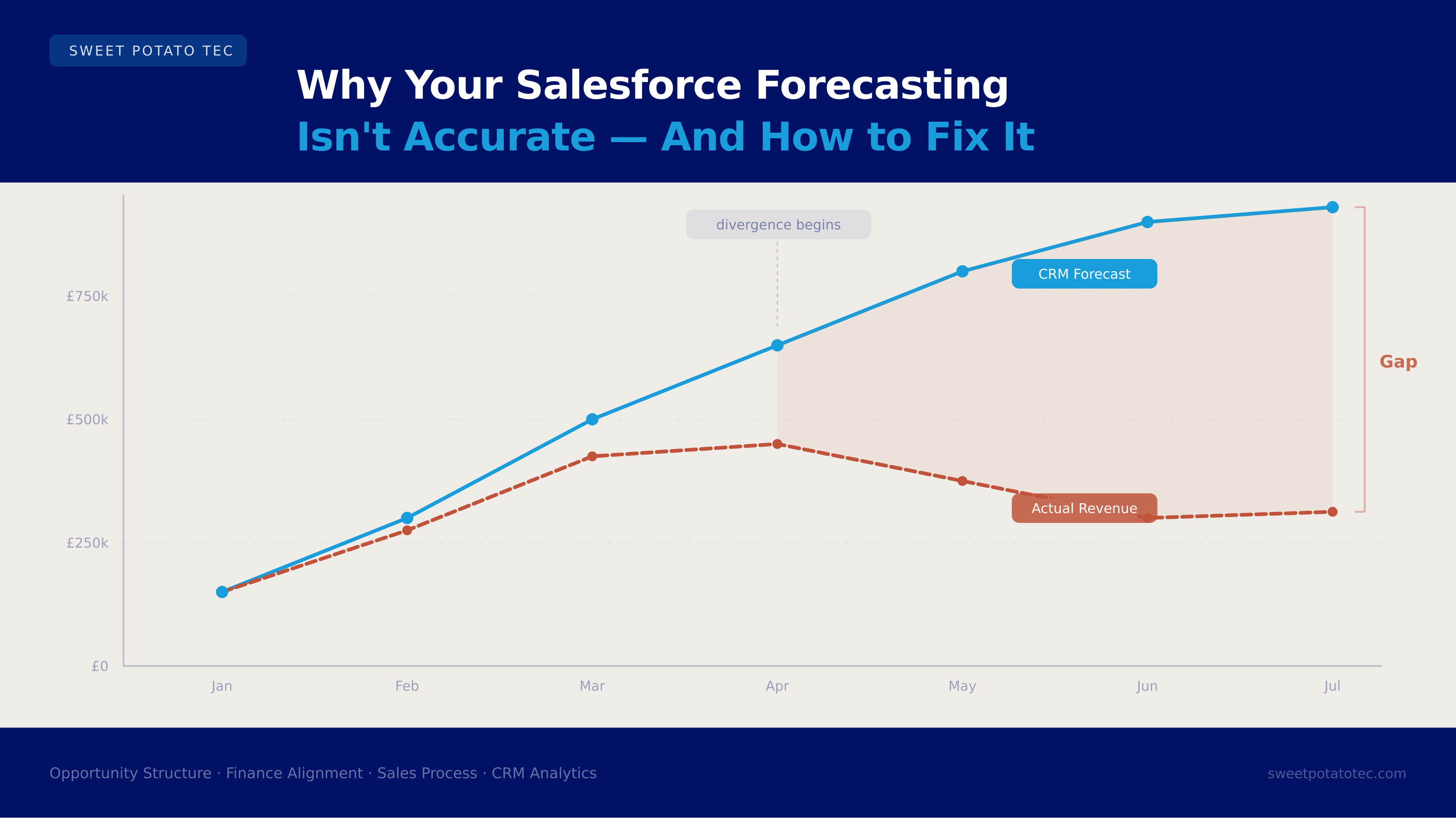
Sales reports show one number. Finance systems show another. Leadership teams spend valuable time reconciling data instead of using it to make decisions.
This challenge appears across many sectors including events, media, SaaS and non profit organisations. Revenue data often sits across multiple systems and the connections between those systems are incomplete.
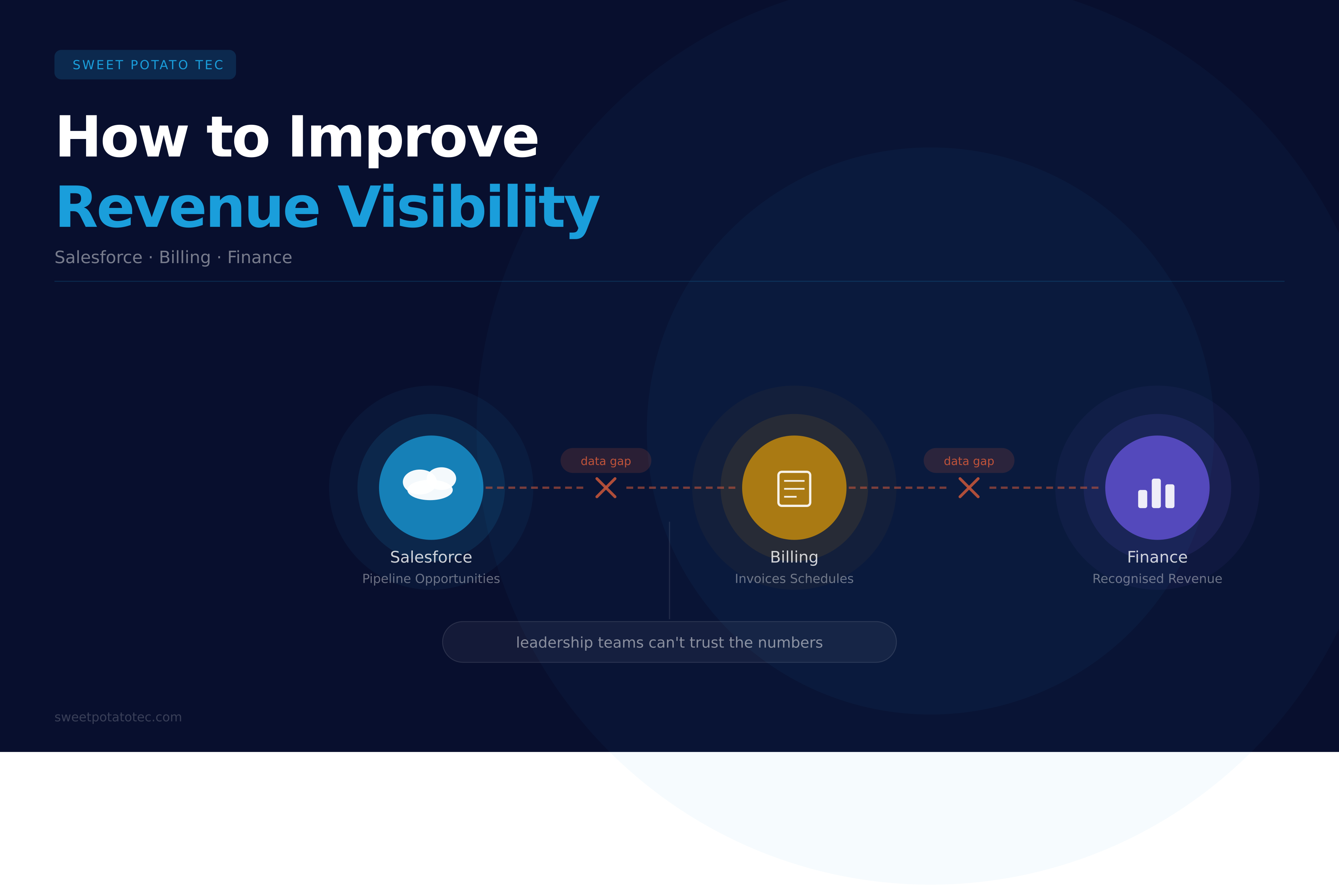
When Salesforce, billing platforms and finance systems are not properly aligned, leadership teams lose the ability to understand how revenue is actually performing.
Improving revenue visibility requires addressing the structural relationship between sales data, billing systems and financial reporting.
Revenue Visibility: Quick Summary
Revenue visibility improves when Salesforce, billing systems and finance platforms are connected through consistent data structures and integrated reporting. When opportunity data, product schedules and invoicing systems are aligned, organisations gain a clear view of pipeline progression, expected revenue and recognised income.
Many organisations achieve this by strengthening integrations, improving opportunity design and introducing analytics tools such as Salesforce CRM Analytics to monitor revenue performance across the entire commercial lifecycle.
The Revenue Lifecycle and Where Visibility Breaks Down
Revenue moves through five stages before leadership sees the final number. Each stage has its own system of record, its own metrics, and its own point where visibility tends to break down.
STAGE 1
Pipeline opportunities
Where the data lives: Salesforce: Opportunity and Opportunity Products.
What leadership should see: Expected value, weighted forecast, stage progression.
Where it usually breaks down: Opportunities bundle multiple revenue streams. Weighting doesn’t reflect real win rates.
STAGE 2
Closed-won deals
Where the data lives: Salesforce: Closed Won Opportunities.
What leadership should see: Booked revenue, contract values, deal terms.
Where it usually breaks down: Contract value disconnected from billing schedule. Deals marked won before contracts close.
STAGE 3
Billing and invoicing
Where the data lives: Finance or billing platform (Sage, NetSuite, Stripe).
What leadership should see: Invoiced amount, billing schedule, outstanding payments.
Where it usually breaks down: Billing runs separately from Salesforce. Invoices issued weeks after deal close.
STAGE 4
Recognised revenue
Where the data lives: Finance system general ledger.
What leadership should see: Revenue earned per period, deferred revenue, MRR or ARR trends.
Where it usually breaks down: Recognition rules don’t map back to opportunity products. Sales and finance totals disagree.
STAGE 5
Leadership view
Where the data lives: Should be unified through CRM Analytics or a BI tool.
What leadership should see: A single view from pipeline through recognised revenue.
Where it usually breaks down: Sales and finance produce different numbers. Leadership reconciles manually in spreadsheets.
The four sections below go deeper into the specific structural issues that cause these breakdowns.
Why Revenue Visibility Breaks Down
1. Sales and Finance Systems Are Not Aligned
In many organisations the sales team and the finance team rely on completely different systems to understand revenue.
Sales teams work in Salesforce where opportunities represent potential deals. Finance teams work in accounting systems where invoices represent confirmed revenue.
When these systems are not aligned, revenue visibility quickly deteriorates. Typical problems include:
- Opportunities showing revenue that has not yet been invoiced
- Finance systems recognising revenue on a different schedule
- Product structures that differ between Salesforce and billing platforms
- Manual reconciliation between pipeline and financial reports
Without consistent data flows between these systems, leadership teams struggle to trust revenue forecasts.
Strengthening the integration between systems through structured Salesforce integration and custom development is often the first step in restoring visibility.
2. Product Structures Do Not Reflect Real Commercial Models
Another common problem occurs when Salesforce product structures do not match how revenue is actually generated.
For example, an events company may sell sponsorship packages, exhibition space and partnership deals within the same opportunity. A media company may combine subscription revenue with advertising and campaign sales. SaaS businesses often manage subscription revenue alongside implementation projects.
If these revenue streams are not structured properly in Salesforce, reporting becomes unreliable.
Revenue visibility improves significantly when opportunity structures are redesigned through a structured Salesforce implementation framework that reflects how the organisation actually sells.
3. Billing Processes Are Disconnected From Sales Activity
In many organisations billing still occurs outside Salesforce.
Deals are closed by the sales team and then passed to finance through spreadsheets or manual workflows. Invoices may be generated weeks after the opportunity closes, creating delays and inconsistencies in reporting.
This gap creates several challenges:
- Revenue recognition delays
- Discrepancies between booked and invoiced revenue
- Limited visibility into billing status
- Manual handoffs between teams
Connecting billing processes directly to Salesforce reduces these gaps and creates a clearer relationship between sales activity and financial reporting.
4. Reporting Is Too Dependent on Static Dashboards
Standard Salesforce reports often provide only a partial view of revenue performance. They typically show pipeline value or closed revenue totals but lack deeper insight into revenue behaviour.
Leadership teams frequently ask questions such as:
- How quickly are deals moving through the pipeline?
- Which products generate the most predictable revenue?
- How do renewals and expansion revenue affect future income?
- Where are revenue delays occurring?
These questions often require deeper analysis. Using tools such as Salesforce CRM Analytics allows organisations to combine pipeline data, billing information and historical trends into a more complete revenue intelligence model.
Building a Revenue Intelligence Model
Improving revenue visibility requires moving beyond simple pipeline reporting. A revenue intelligence model connects sales activity, financial data and operational metrics into a unified view of revenue performance.
Key components usually include:
- Clearly structured opportunity and product models
- Integrated billing and finance systems
- Consistent revenue schedules
- Analytics dashboards tracking pipeline pacing and revenue trends
Organisations often develop these capabilities through strategic transformational Salesforce consulting that aligns the CRM platform with broader operational and financial processes.
Creating Ongoing Visibility Through Governance
Even the best system architecture requires strong operational governance. Revenue visibility improves when organisations establish consistent processes around pipeline management and financial alignment.
This often includes:
- Regular pipeline review meetings
- Clear definitions of revenue stages and forecasting categories
- Automated billing workflows
- Shared reporting between sales and finance teams
Maintaining these processes over time is often supported through ongoing Salesforce managed services and support to ensure the platform evolves with the organisation’s growth.
Key Takeaways
- Revenue visibility depends on alignment between Salesforce, billing systems and finance platforms.
- Poor opportunity structures often prevent accurate reporting.
- Integrations between sales and finance systems are critical for reliable revenue data.
- CRM Analytics enables deeper insight into pipeline performance and revenue trends.
When these elements are aligned, Salesforce becomes far more than a sales tracking tool. It becomes a reliable system for understanding and managing revenue across the organisation.
FAQ
Why do Salesforce and finance reports often show different revenue numbers?
This usually happens when Salesforce opportunities are not connected directly to billing systems or when revenue schedules differ between sales and finance platforms.
How can organisations improve revenue visibility in Salesforce?
Improving visibility typically requires stronger integrations between Salesforce and finance systems, better opportunity structures and more advanced analytics.
Can Salesforce track both pipeline and recognised revenue?
Yes. With the correct configuration Salesforce can track both potential revenue and invoiced revenue, especially when billing integrations and analytics tools are implemented.
What tools help improve revenue visibility in Salesforce?
Tools such as CRM Analytics allow organisations to combine pipeline data, billing data and historical trends to create a more complete view of revenue performance.