
Salesforce is often positioned as the single source of truth for customer and revenue data. Leadership teams expect reports to reflect what is really happening across the organisation. Pipeline performance, revenue forecasts and operational metrics should all be visible in one place.
Yet many organisations quickly lose confidence in the reports produced by their CRM.
Sales teams rely on spreadsheets to verify numbers. Finance teams run separate reconciliation reports. Leadership meetings become discussions about which data is actually correct.
This situation is far more common than many organisations realise. Across sectors such as events, media, SaaS and non profits we regularly see reporting problems that stem from structural issues inside Salesforce rather than the reporting tools themselves.
When the underlying data model and operational processes are not aligned with how the organisation actually works, reports inevitably become unreliable.
Salesforce Reporting Accuracy: Quick Summary
Salesforce reports become unreliable when the underlying CRM structure does not match how the organisation operates. Common causes include inconsistent data entry, poorly structured opportunity models, disconnected integrations and reporting layers that were never designed to support leadership level decision making.
Improving reporting accuracy usually requires reviewing the data model, strengthening system integrations and introducing deeper analytics through tools such as Salesforce CRM Analytics to monitor revenue, pipeline and operational performance.
Run a Salesforce Reporting Health Check
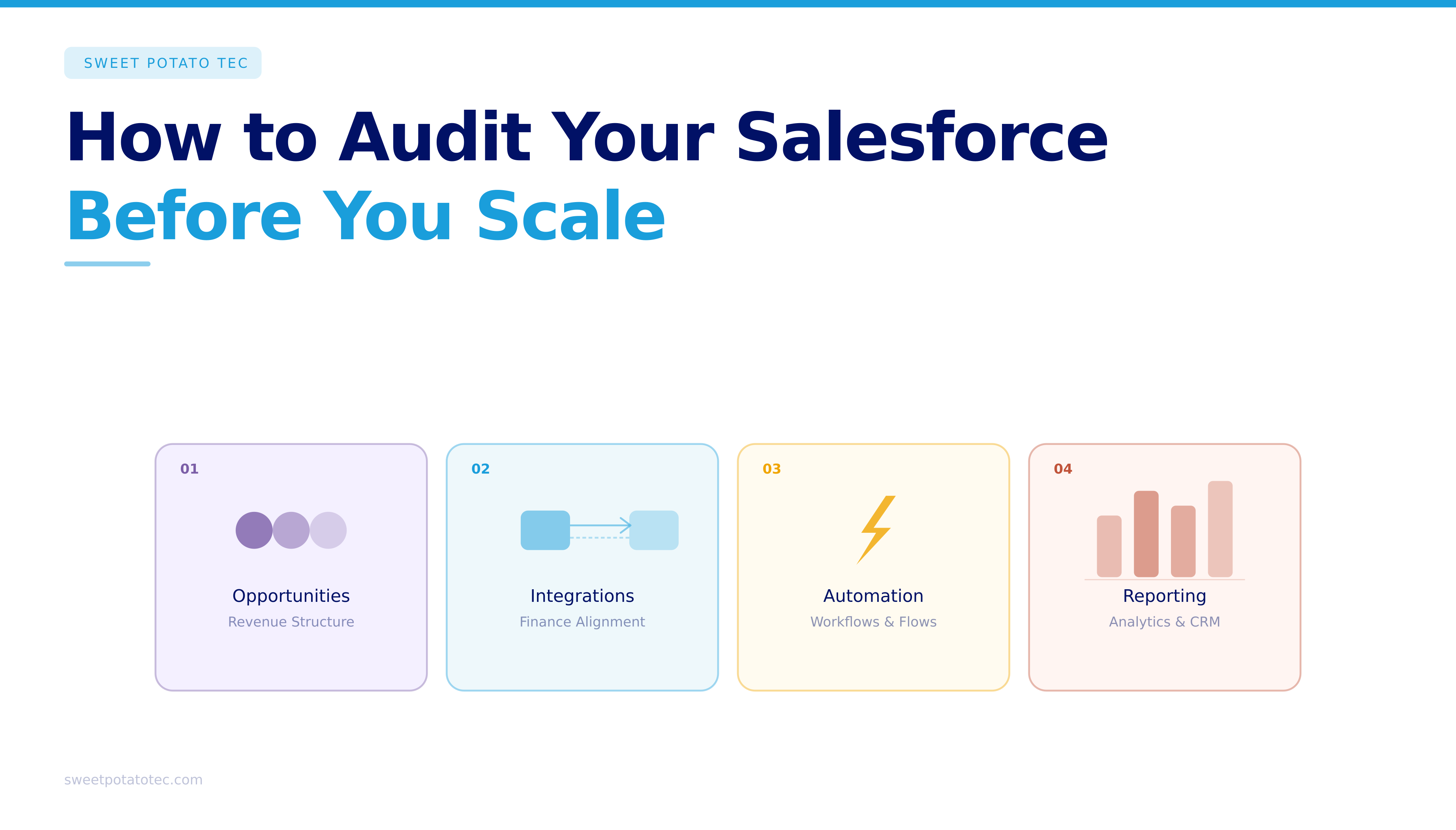
Before fixing reporting accuracy it helps to know exactly where the gaps are. The checks below cover the four areas that most commonly affect reliability. The more you can confirm, the stronger your reporting foundation.
DATA CONSISTENCY
✓All sales teams interpret opportunity stages the same way.
✓Required fields and field definitions are documented and enforced.
✓An active process exists to identify and merge duplicate records.
OPPORTUNITY MODEL
✓Opportunity structures reflect how revenue is actually generated.
✓Each revenue stream within a deal can be reported on separately.
✓Product schedules align with how revenue is billed and recognised.
INTEGRATIONS
✓Revenue data syncs cleanly between Salesforce and finance systems.
✓Billing updates appear in Salesforce without manual intervention.
✓Product data is consistent between Salesforce and finance tools.
LEADERSHIP REPORTING
✓Leadership can see pipeline pacing without exporting to spreadsheets.
✓Renewal and expansion revenue are tracked separately from new bookings.
✓You can identify where deals are stalling without manual analysis.
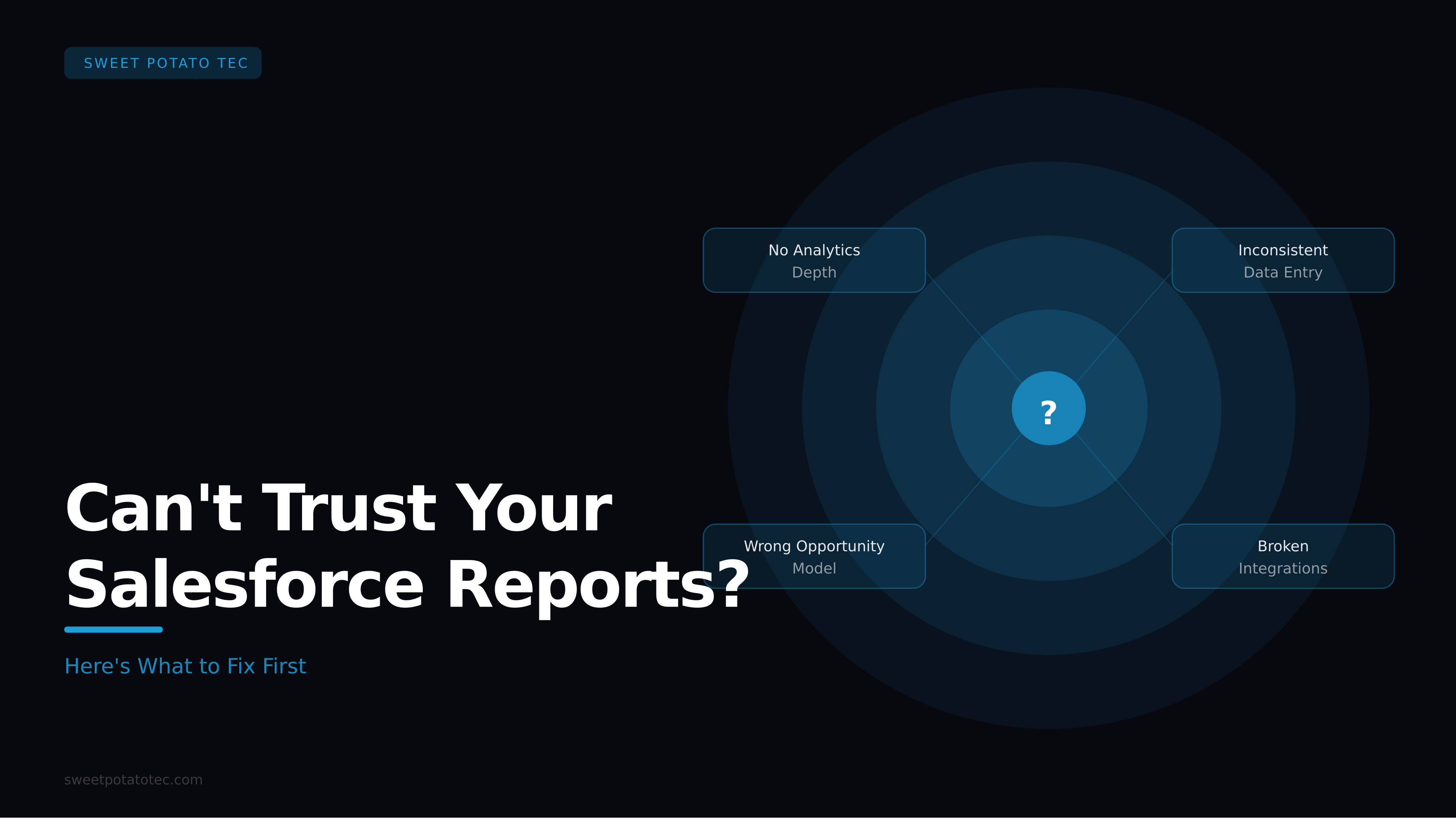
Gaps in any of these areas tend to point to one of the four structural issues described below.
Why Salesforce Reports Become Unreliable
1. Inconsistent Data Across Teams
The most common cause of unreliable Salesforce reporting is inconsistent data entry. Different teams often interpret fields, opportunity stages and account structures differently. Over time this creates large inconsistencies across the CRM.
Typical symptoms include:
- Opportunities missing key revenue information
- Duplicate accounts or contacts
- Inconsistent opportunity stages across different sales teams
- Incomplete product or pricing data
When the underlying data is inconsistent, even well designed reports will produce misleading results. Many organisations address these issues by introducing stronger governance and ongoing monitoring through structured Salesforce managed services and support.
2. Opportunity Models That Do Not Reflect the Business
Another common problem occurs when the opportunity structure does not match the organisation’s commercial model. This is particularly common in sectors with complex revenue structures.
For example:
- Events companies may sell sponsorship packages, exhibition stands and partnerships through the same opportunity.
- Media organisations may combine advertising, subscription and campaign revenue in a single pipeline.
- SaaS businesses often manage subscriptions, implementation services and expansion revenue within the same deal structure.
When opportunity structures are not designed correctly, Salesforce reports struggle to represent revenue accurately. Reviewing the opportunity model as part of a structured Salesforce implementation framework can significantly improve reporting reliability.
3. Disconnected Integrations Between Systems
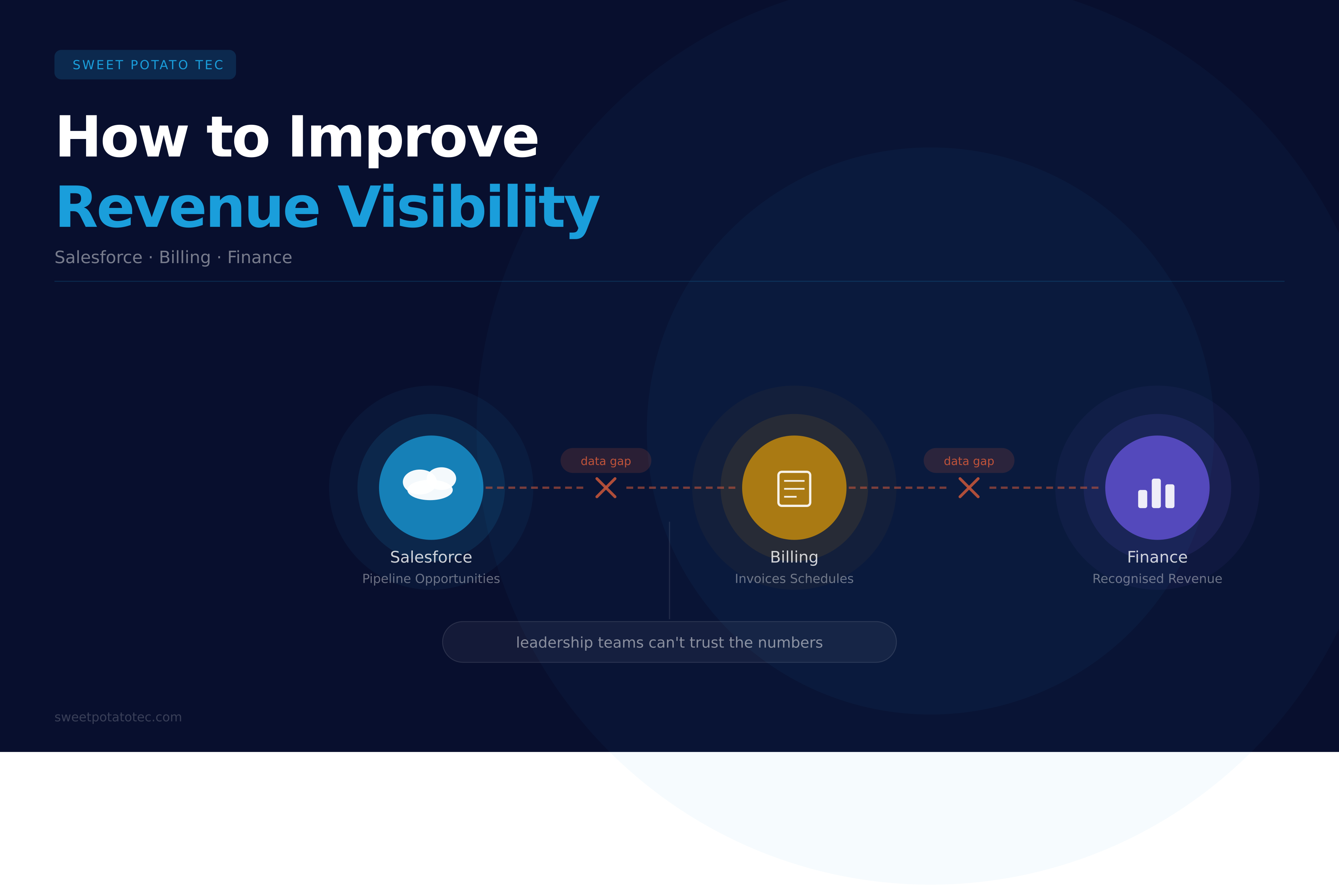
Salesforce rarely operates in isolation. Many organisations integrate their CRM with finance platforms, billing systems, marketing tools and data warehouses. When these integrations are poorly configured or incomplete, reporting discrepancies quickly appear.
Common integration issues include:
- Revenue data not synchronising correctly between systems
- Delayed updates from billing platforms
- Product data differing between Salesforce and finance tools
- Missing financial reconciliation fields
Resolving these issues often requires strengthening the technical architecture through improved Salesforce integration and custom development.
4. Reporting That Was Never Designed for Leadership Decisions
Standard Salesforce reports are useful for operational visibility but they often lack the depth required for strategic decision making.
Leadership teams frequently ask questions that traditional reports struggle to answer, such as:
- Which revenue streams are most predictable?
- How does pipeline pacing compare with historical performance?
- Where are delays occurring between sales and billing?
- How do renewals and expansion revenue affect future growth?
These types of insights require deeper analytics. Using tools such as Salesforce CRM Analytics allows organisations to combine operational data with historical performance trends and build far more sophisticated reporting models.
How to Restore Trust in Salesforce Reporting
Improving reporting accuracy usually requires addressing both technical and operational issues.
Key steps often include:
- Standardising opportunity structures and revenue models
- Introducing clearer data governance policies
- Aligning Salesforce with billing and finance platforms
- Implementing advanced analytics dashboards for leadership teams
Many organisations approach this through broader CRM optimisation initiatives supported by strategic transformational Salesforce consulting that align the platform with operational and financial processes.
Creating a Sustainable Reporting Framework
Fixing reporting accuracy is not a one time exercise. As organisations grow, their commercial models become more complex and their reporting needs evolve.
A sustainable reporting framework usually includes:
- Clearly defined data ownership across teams
- Consistent definitions of key revenue and pipeline metrics
- Automated data quality monitoring
- Shared reporting dashboards used by both sales and finance teams
When these elements are in place Salesforce becomes far more than a sales tracking tool. It becomes a reliable platform for understanding performance across the entire organisation.
Key Takeaways
- Salesforce reports become unreliable when the CRM data structure does not reflect how the organisation operates.
- Inconsistent data entry is one of the most common causes of reporting problems.
- Opportunity structures must reflect real revenue models to produce accurate reports.
- CRM Analytics enables deeper reporting and revenue visibility across complex organisations.
When these structural issues are addressed Salesforce can become a reliable source of operational and financial insight.
FAQ
Why are Salesforce reports often inaccurate?
Salesforce reports are usually inaccurate when underlying CRM data is inconsistent or when opportunity structures do not reflect how revenue is generated.
How can organisations improve Salesforce reporting accuracy?
Improving reporting accuracy typically involves cleaning CRM data, standardising opportunity structures, strengthening integrations and introducing advanced analytics tools.