
Salesforce often starts as a straightforward system. A few pipelines, some basic reporting, and a handful of integrations can support a growing organisation quite well.
But as companies scale, complexity increases quickly.
New products are introduced. Pricing models evolve. Sales teams expand. Integrations with finance systems and operational platforms become more important. Over time, the Salesforce environment becomes more complex than originally planned.
Many organisations only discover problems when the system begins to struggle under this growth.
Reports become unreliable. Automation stops behaving predictably. Integrations break. Teams start creating workarounds outside the CRM.
A structured Salesforce audit helps identify these issues before they begin to affect performance, reporting and revenue visibility.
Salesforce Audit: Quick Summary
A Salesforce audit evaluates how well the platform supports an organisation’s revenue model, operational processes and reporting requirements. The review typically focuses on opportunity structure, data quality, integrations, automation and reporting architecture.
Many organisations use this process to prepare their system for growth and ensure Salesforce can support scaling operations. Tools such as Salesforce CRM Analytics often play an important role in improving visibility across sales performance and revenue reporting.
Why Salesforce Setups Often Struggle as Companies Grow
Salesforce environments often evolve organically. As organisations grow, new processes and products are introduced into the CRM without revisiting the original system architecture.
Over time this can create several challenges:
- Duplicate or inconsistent data structures
- Automation processes that conflict with each other
- Integrations that were built for earlier business models
- Reporting frameworks that no longer reflect how revenue works
Without a structured review these issues accumulate and begin to affect system performance. In many cases organisations discover that the CRM design no longer reflects how the business actually operates.
The 5-Stage Salesforce Audit Checklist
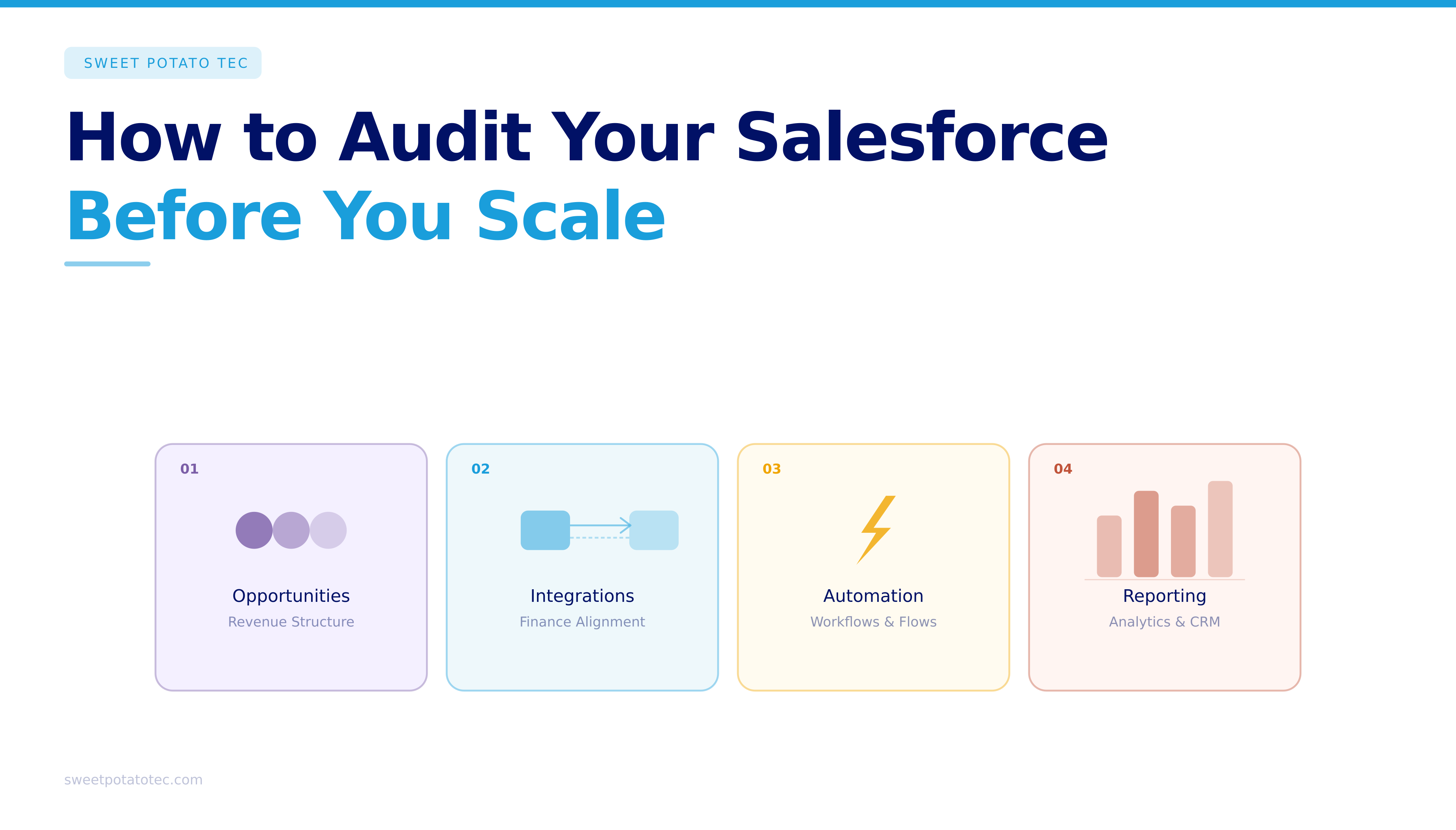
A structured audit moves through five stages. Each one tackles a different layer of the platform, from the commercial model at the top to the governance framework underneath.
STAGE 1
Opportunity & Revenue Structure
Review: opportunity design, product and pricing models, revenue schedules, forecasting categories.
Confirms: pipeline reporting reflects how revenue actually flows.
STAGE 2
Integrations with Finance & Operational Systems
Review: data sync between Salesforce and finance, billing alignment, integration workflows, invoice update flows.
Confirms: Salesforce stays aligned with the wider technology ecosystem.
STAGE 3
Automation & Workflow Processes
Review: flow logic, duplicate automations, approval complexity, manual tasks that should be automated.
Confirms: automation is predictable and reduces operational risk.
STAGE 4
Reporting & Analytics Capability
Review: reporting structure, dashboard relevance, leadership visibility, analytics tools in use.
Confirms: leadership teams have the visibility they need for strategic decisions.
STAGE 5
Governance & Ownership
Review: data ownership, automation review cycles, pipeline management discipline, shared visibility across teams.
Confirms: the platform can evolve with the organisation rather than drift out of step.
Reviewing the Opportunity and Revenue Structure
One of the first areas to review during a Salesforce audit is the opportunity structure.
Opportunities often evolve as organisations introduce new commercial models such as subscription products, event sponsorship packages or bundled services. When these structures are not designed carefully, revenue reporting becomes inconsistent.
An audit should review:
- How opportunities represent revenue streams
- How products and pricing models are configured
- Whether revenue schedules align with billing processes
- Whether forecasting categories reflect actual deal progression
In some cases the audit highlights the need for improvements within the organisation’s broader Salesforce implementation strategy to ensure the platform supports the current commercial model.
Evaluating Integrations with Finance and Operational Systems
Salesforce rarely operates in isolation. Most organisations rely on integrations with finance systems, marketing platforms, billing tools and operational software. As companies scale these integrations become more critical.
Common issues discovered during audits include:
- Incomplete data synchronisation between systems
- Revenue information handled differently by sales and finance
- Integration workflows that no longer support current processes
- Delays in updating billing or invoice data
Reviewing integration architecture ensures that Salesforce remains aligned with the broader technology ecosystem. Strengthening these connections through structured Salesforce integration and custom development often resolves many operational bottlenecks.
Reviewing Automation and Workflow Processes
Automation is one of Salesforce’s most powerful capabilities. It can also become one of the most complex areas of the system.
Over time organisations introduce flows, triggers and workflow automation to support new processes. Without proper governance these automations may begin to conflict with each other or produce unexpected outcomes.
A Salesforce audit should examine:
- Automation logic across flows and workflows
- Duplicate automation processes
- Unnecessary complexity within approval processes
- Areas where automation should replace manual tasks
Cleaning up automation improves system reliability and reduces operational risk.
Assessing Reporting and Analytics Capabilities
As organisations grow leadership teams require deeper insight into revenue performance, pipeline trends and operational efficiency. Standard reports may not always provide the level of visibility needed to support strategic decisions.
A Salesforce audit should evaluate:
- The structure of reporting frameworks
- Whether dashboards reflect current commercial models
- Whether leadership teams have sufficient revenue visibility
- Opportunities to improve reporting through analytics tools
Introducing deeper analysis through Salesforce CRM Analytics can help organisations understand revenue trends, pipeline pacing and deal progression far more effectively.
Establishing Governance for Long Term Growth
A successful Salesforce audit does more than identify technical issues. It also helps organisations establish governance frameworks that support long term growth.
These typically include:
- Defined ownership of data structures and processes
- Regular review of automation and integrations
- Consistent pipeline management processes
- Shared visibility between sales, operations and finance teams
Maintaining this structure often requires ongoing platform management supported by Salesforce managed services and support to ensure the system evolves with the organisation.
In more complex cases organisations undertake a broader platform review through transformational Salesforce consulting to align the CRM architecture with strategic growth plans.
Key Takeaways
- Salesforce systems often evolve organically and become complex as organisations scale.
- Opportunity structures and revenue models should be reviewed regularly.
- Integrations with finance and operational systems play a critical role in revenue visibility.
- Automation and reporting frameworks must evolve alongside business growth.
Conducting a structured Salesforce audit allows organisations to address these issues early and ensure the platform remains a reliable foundation for growth.
FAQ
What is included in a Salesforce audit?
A Salesforce audit usually reviews opportunity structures, data quality, integrations, automation workflows and reporting frameworks to ensure the platform supports the organisation’s operational model.
When should organisations audit their Salesforce setup?
An audit is often recommended when organisations scale rapidly, introduce new revenue models or experience reporting inconsistencies within the CRM.
Can a Salesforce audit improve forecasting accuracy?
Yes. Reviewing opportunity structures, automation processes and integrations often resolves many of the issues that affect forecasting accuracy.
How often should Salesforce systems be reviewed?
Many organisations conduct structured system reviews annually or during major operational changes such as new product launches or system integrations.