

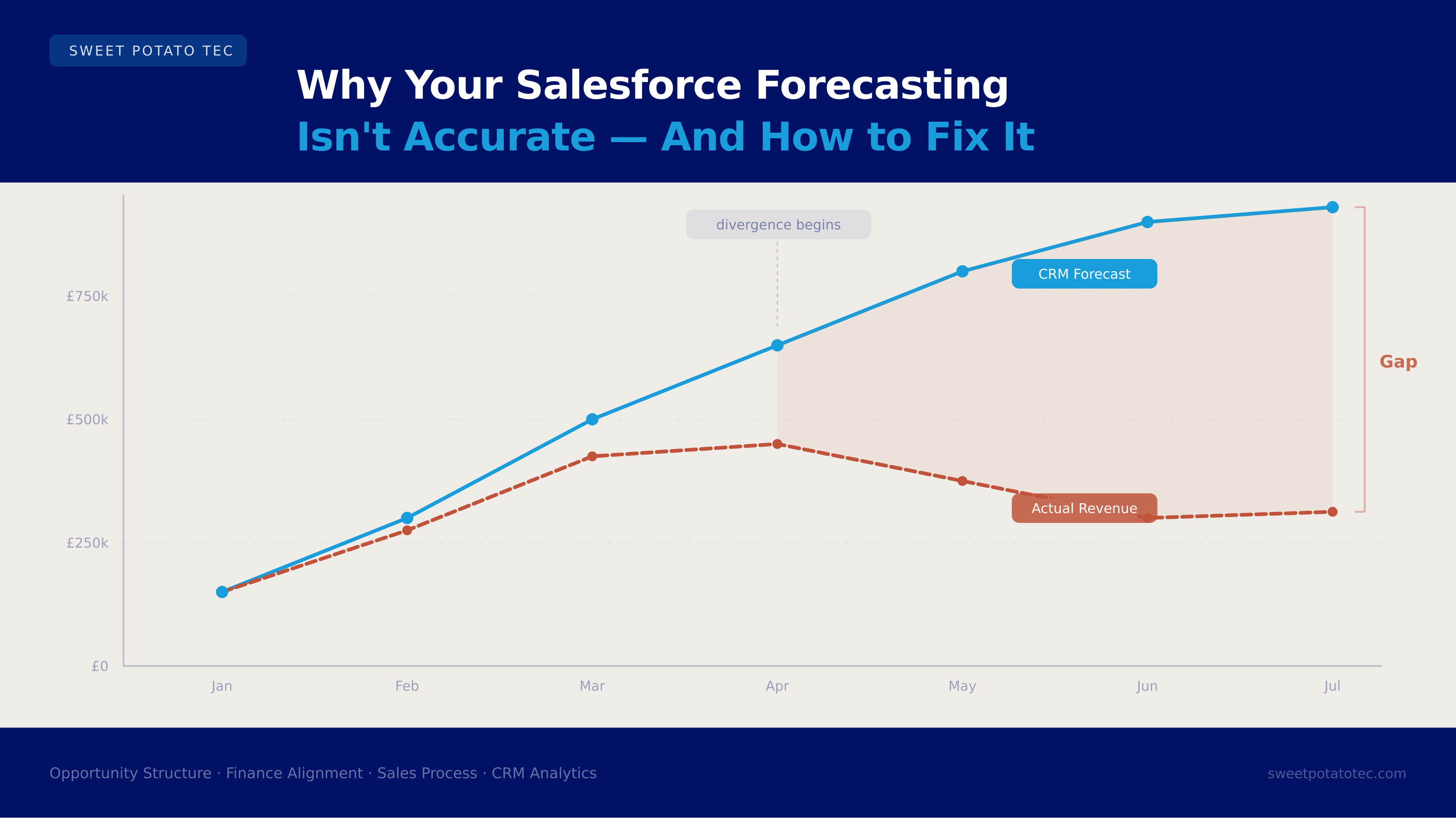
Salesforce forecasting should give leadership teams a reliable view of future revenue. Pipeline coverage, expected bookings and deal pacing should all be visible in one place.
Yet many organisations discover the opposite.
Forecasts shift unexpectedly. Leadership teams lose confidence in the numbers. Finance teams create parallel spreadsheets to validate pipeline projections. Reporting meetings become debates about which numbers are correct.
Across sectors such as events, media, SaaS and non-profits we repeatedly see the same underlying causes. The problem is rarely Salesforce itself. The issue is usually how the platform has been structured around the organisation’s revenue model.
Salesforce Forecasting Accuracy: Quick Summary
Salesforce forecasting becomes inaccurate when the CRM structure does not reflect how revenue is actually generated. The most common causes include poorly structured opportunities, inconsistent sales processes, weak integrations with finance systems and limited visibility across multiple revenue streams.
Improving forecasting accuracy usually requires restructuring pipeline data, aligning Salesforce with billing and finance platforms, and introducing stronger analytics using tools such as Salesforce CRM Analytics to monitor pipeline pacing, deal progression and revenue performance.
How to Diagnose a Forecasting Problem
Most forecasting problems show up first as a symptom leadership notices, long before anyone identifies the underlying cause. The table below maps the most common symptoms back to what’s usually wrong and where to look inside Salesforce.
SYMPTOM 1
Forecasts swing wildly from month to month
Underlying cause: A single opportunity holds multiple revenue streams that don’t behave the same way.
Where to look in Salesforce: Opportunity Products, Schedule Setup, CPQ pricing logic.
SYMPTOM 2
Salesforce forecast and finance system disagree
Underlying cause: Billing and product schedules aren’t aligned with CRM revenue logic.
Where to look in Salesforce: Product Schedules, revenue recognition integration, billing platform sync.
SYMPTOM 3
Pipeline coverage looks healthy but bookings come in low
Underlying cause: Teams interpret stages and forecast categories differently.
Where to look in Salesforce: Forecast Categories, Stage definitions, Sales Process settings.
SYMPTOM 4
Leadership sees the total but not the story behind it
Underlying cause: Standard reports can’t surface pacing, renewals or product level trends.
Where to look in Salesforce: CRM Analytics dashboards, Opportunity Product reports, renewal pipeline.
The Most Common Causes of Salesforce Forecasting Problems
1. Opportunity Structures That Do Not Reflect Real Revenue
In many organisations opportunities are created before the revenue model has been properly defined.
For companies managing complex commercial structures such as sponsorship packages, advertising bundles or subscription products a single opportunity may represent several revenue streams at once.
Typical examples include:
- Sponsorship revenue combined with exhibitor bookings
- Subscription revenue mixed with campaign or project work
- Contract values disconnected from billing schedules
When opportunities are structured this way Salesforce forecasting becomes unreliable because the pipeline does not reflect how revenue actually flows through the business. Over time leadership teams lose confidence in the CRM as a source of truth.
Often the solution requires revisiting the underlying data model as part of a structured Salesforce implementation approach that aligns the system with the organisation’s commercial model.
2. Weak Alignment Between Salesforce and Finance Systems
Forecasting accuracy also depends heavily on how Salesforce connects to finance and billing systems.
Many organisations integrate Salesforce with platforms such as Sage or NetSuite but the underlying revenue logic is often incomplete. This is particularly common in sectors like events and SaaS where revenue timing can be complex.
Typical problems include:
- Billing schedules not matching opportunity revenue
- Product schedules configured incorrectly
- Revenue recognition rules managed outside Salesforce
- Pipeline updates not reflected in finance systems
When these systems drift apart forecasts quickly diverge from financial reporting. Strengthening Salesforce integration and custom development often resolves these gaps and restores alignment between pipeline and finance data.
3. Inconsistent Sales Processes Across Teams
Technology alone cannot fix forecasting problems. In many organisations different teams interpret pipeline stages and forecasting categories differently.
Common symptoms include:
- Deals remaining in late stage pipeline positions for months
- Inconsistent use of forecasting categories
- Pipeline updates lagging behind real deal progression
When forecasting depends on inconsistent processes accuracy inevitably declines. Strong governance and operational discipline are essential. Many organisations introduce this through ongoing Salesforce managed services and support to ensure processes remain consistent as the business evolves.
4. Limited Visibility Across Multiple Revenue Streams
Many organisations operate several commercial models simultaneously:
- Events companies manage sponsorship, exhibitor and partnership revenue.
- Media organisations combine subscription, advertising and campaign sales.
- SaaS businesses manage new bookings, renewals and expansion revenue.
Standard Salesforce reporting often struggles to provide a clear view across these revenue streams. Leadership teams may see total pipeline value but lack visibility into the revenue behaviour driving those numbers.
Introducing deeper analytics through Salesforce CRM Analytics allows organisations to analyse pipeline pacing, historical deal patterns and product level revenue performance in far greater detail. This gives leadership teams much greater confidence in forecast projections.
Fixing the Data Model Behind Salesforce Forecasting
One of the most effective ways to improve forecasting accuracy is to review the underlying Salesforce architecture.
Over time organisations introduce new products, pricing models, integrations and automation layers. Without careful design this complexity makes forecasting increasingly difficult.
Improving forecasting reliability usually involves reviewing:
- Opportunity product structures
- Pricing and discounting logic in CPQ
- Revenue schedules and billing integrations
- Reporting models and analytics architecture
In many cases this work forms part of a broader transformational Salesforce consulting engagement designed to align the platform with the organisation’s operational and revenue model.
Key Takeaways
- Salesforce forecasting becomes inaccurate when CRM structures do not match the organisation’s revenue model.
- Weak alignment between Salesforce and finance systems often creates forecasting discrepancies.
- Inconsistent sales processes reduce forecast reliability.
- CRM Analytics can significantly improve forecasting visibility and accuracy.
When Salesforce is structured around the real commercial model of the business leadership teams gain a much clearer view of pipeline performance and future revenue.
FAQ
Why is Salesforce forecasting often inaccurate?
Forecasting problems usually occur when opportunity structures, product models and reporting layers do not reflect how revenue is actually generated within the organisation.
How can CRM Analytics improve Salesforce forecasting?
CRM Analytics allows organisations to analyse pipeline pacing, deal progression and revenue trends helping leadership teams produce more reliable forecasts.
Can Salesforce forecast complex revenue models?
Yes. Salesforce can support complex commercial models such as subscription, sponsorship or bundled products but the data structure and reporting architecture must be configured correctly.
When should you review your Salesforce forecasting setup?
If forecasts regularly diverge from financial reporting or leadership teams rely on spreadsheets to validate CRM data it is usually time to review the forecasting architecture.
Related posts:
 Salesforce Forecasting: A Strategic Tool for Sales Excellence
How a Global Software Company Transformed Revenue Intelligence with Predictive Forecasting in Salesforce CRM Analytics
Salesforce Forecasting: A Strategic Tool for Sales Excellence
How a Global Software Company Transformed Revenue Intelligence with Predictive Forecasting in Salesforce CRM Analytics
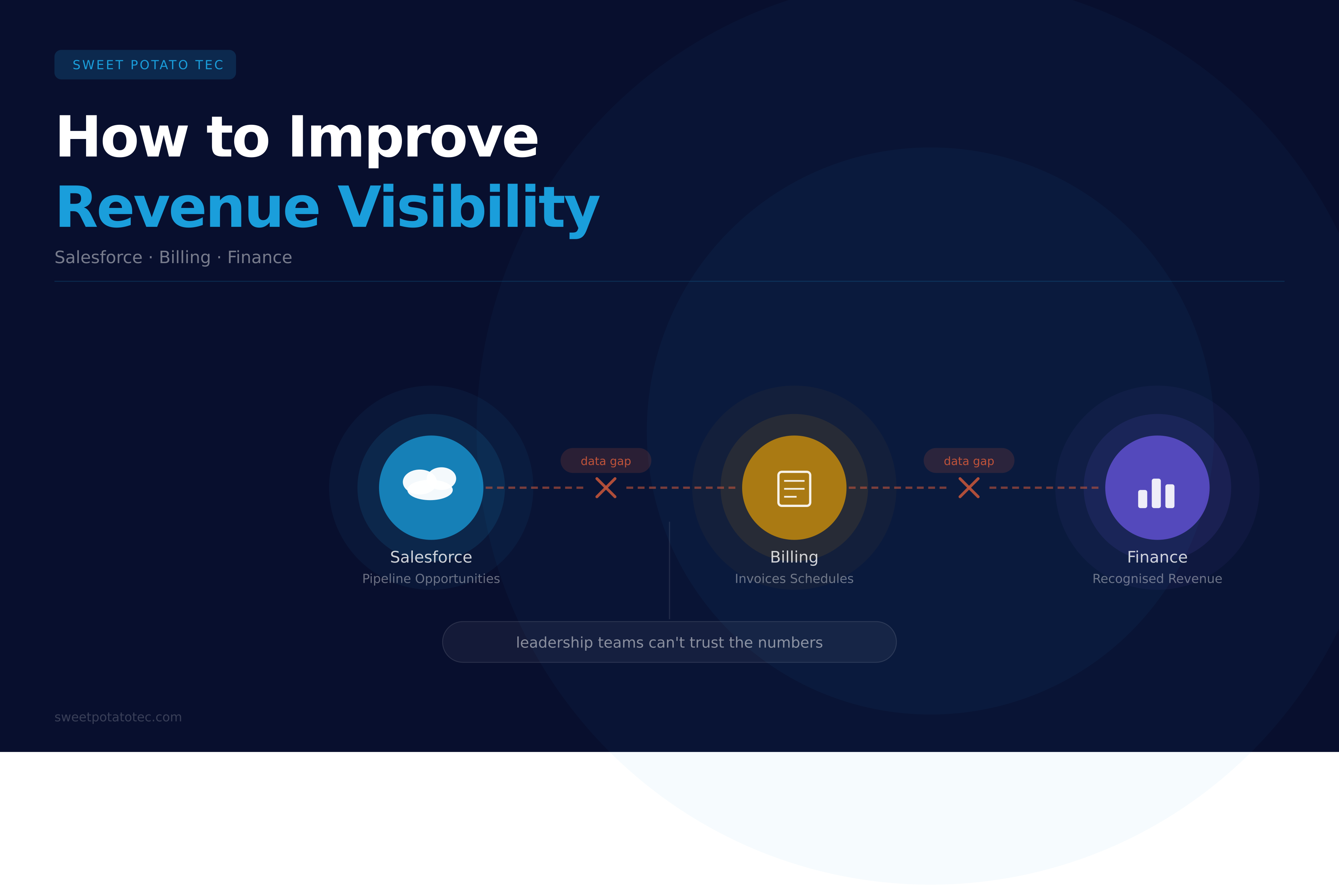 How to Improve Revenue Visibility Across Salesforce, Billing and Finance
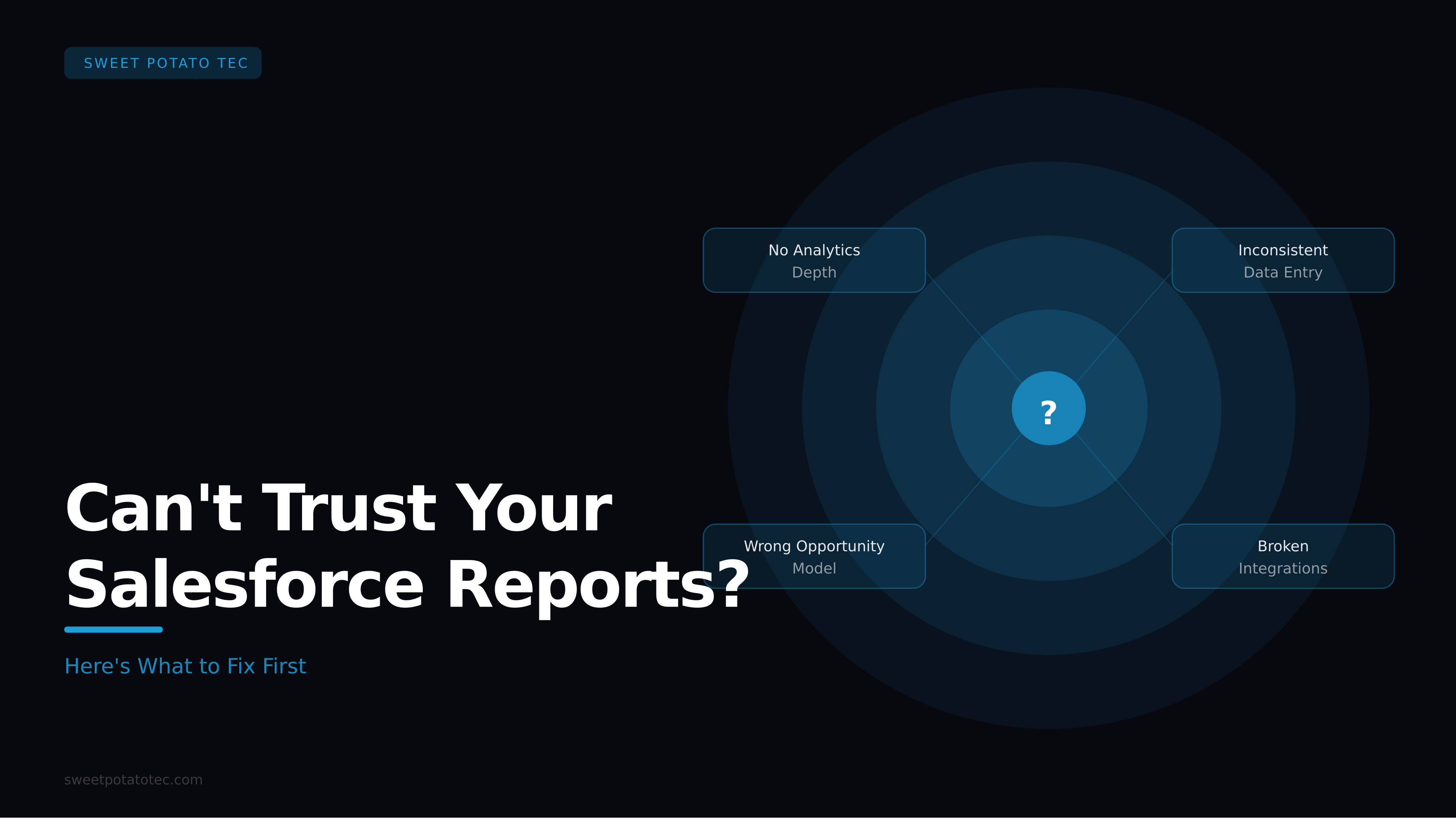 Can’t Trust Your Salesforce Reports? Here’s What to Fix First